 EN
EN  VI
VI  JA
JA Sheet metal bending is a crucial step in shaping products during mechanical processing. However, regardless of the level of modern machinery used, without precise bending techniques and experienced material handling, processing workshops are still very susceptible to risks that damage workpieces, causing serious losses in terms of schedule and costs.
Below are the 5 most common metal bending errors and how engineers at Metaltech 1 factory fix them, especially the secret technique for bending stainless steel without scratching the surface.
1. Fracture or cracking of the workpiece at the bending angle.
This is an extremely serious defect that directly reduces the product's load-bearing capacity.
- Reason: This is often due to the technician choosing an inside radius that is too small for the thickness of the metal sheet, or because the bending path is placed parallel to the rolling direction (grain direction) of the steel workpiece.
- How to fix it: * Follow the rule for selecting the minimum bending radius (usually R must be greater than or equal to the material thickness T).
- Applying smart bending techniques: Rotate the bending direction perpendicular (or at least at a 45-degree angle) to the grain direction of the metal to increase the ductility of the bending angle.

2. Surface scratches on the material
Interior decoration products, medical equipment, or elevators made from stainless steel (especially hairline brushed or mirror-polished stainless steel) demand absolute aesthetic appeal. Scratching the surface due to the die is the biggest "pain point" for customers when outsourcing fabrication.
- Reason: When the punch presses the workpiece down into the V-shaped die, the sliding friction between the metal surface and the die edge creates indentations and scratches that extend along the bend.
- Solution at Metaltech 1 (Scratch-free stainless steel bending): We completely eliminate this risk by using a specialized protective plastic film (Urethane/Polyurethane film) to line the die surface before pressing the workpiece.
This elastic membrane acts as a cushion, completely isolating the stainless steel/aluminum surface from direct friction with the hard steel die. Thanks to folding technique Thanks to this meticulous process, the mirror-polished stainless steel products manufactured at Metaltech 1 always maintain an intact, shiny surface without any imperfections or grooves.
3. Angle deviation of the shock
The drawing required bending at a 90-degree angle, but after lifting the punch, the metal sheet returned to a 92-degree angle.
- Reason: All metals have a natural elasticity. When the force of the bending machine is released, the material will tend to "release" some of the bending angle (springback).
- How to fix it: * Technicians must calculate the elastic modulus of each material (stainless steel has higher elasticity than mild steel) to perform over-bending. For example, bending down to 88 degrees so that when released, the material fits perfectly at 90 degrees.
- We use a modern CNC bending machine system with an automatic angle compensation function (Crowning system).
4. Deformation and distortion of the holes drilled near the indentation line.
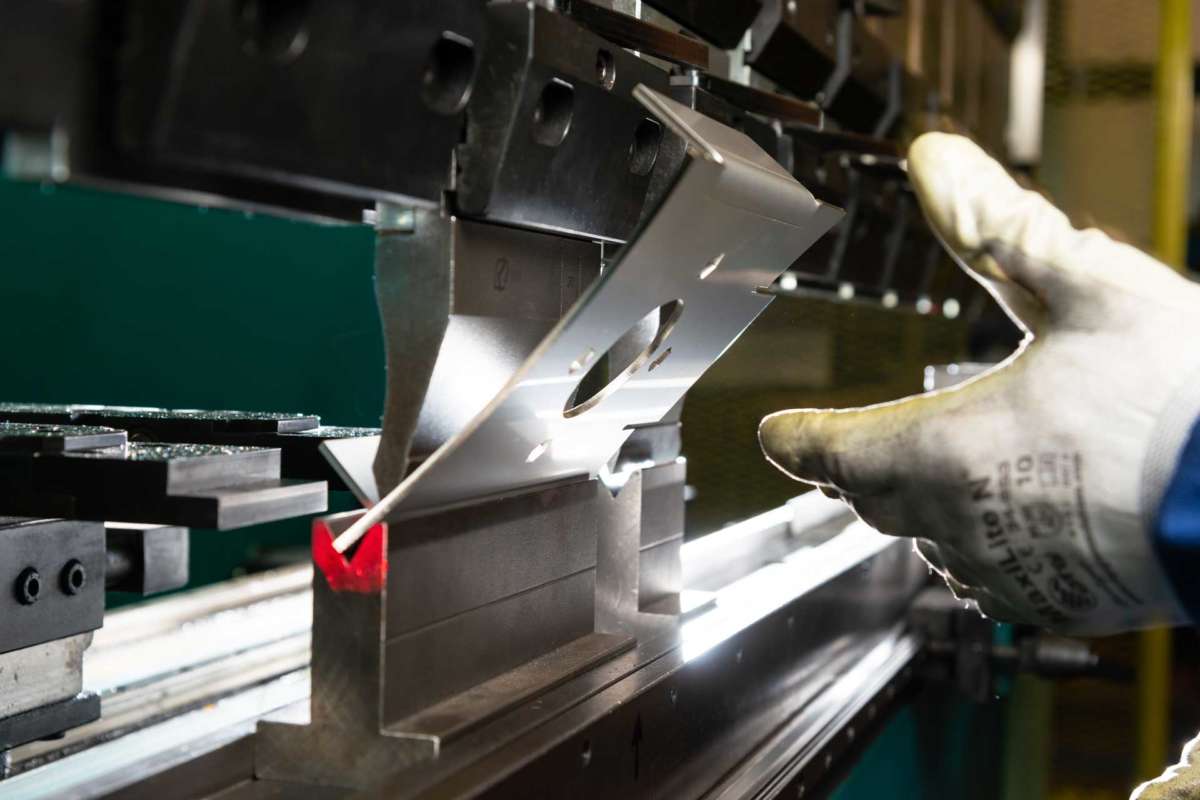
Many drawings require holes for screws, but after passing through the bending machine, the circular holes are stretched into oval shapes, making assembly impossible.
- Reason: The hole is located too close to the indentation line (within the compressive/tensile stress zone of the material).
- How to fix it: Design engineers must adhere to safety distances: The distance from the edge of the hole to the center of the bending curve must be at least 2.5 to 3 times the material thickness plus the bending radius. If a hole is absolutely necessary near the bending edge, solutions such as drilling a pressure relief groove nearby or bending the material first and then machining the hole can be applied.
5. Discrepancies in the dimensions of the edges.
- Reason: This error usually doesn't originate from the bending machine itself, but rather from another component. initial workpiece cutting process The dimensions are incorrect, or the worker doesn't push the workpiece tightly into the backgauge.
- How to fix it: At Metaltech 1, we maintain strict control from the initial blank creation stage using our system. Advanced CNC Laser Cutting Machine (Error margin is only ±0.05mm). Precise input workpieces combined with a multi-axis automatic CNC jig system on the bending machine ensure that the dimensions of the folded edges are always perfect and consistent throughout the entire batch.
Trust Metaltech 1 for your bending and folding needs.
Understanding metalworking defects and mastering preventative methods is a measure of the skill of a professional fabrication unit.
If your business needs a partner capable of machining complex parts, requiring tight tolerances, and especially requiring scratch-free stainless steel bending, Metaltech 1 is the top choice in the Dong Nai area. Our synchronized CNC machinery system and team of experienced engineers are always ready to support you.
