 EN
EN  VI
VI  JA
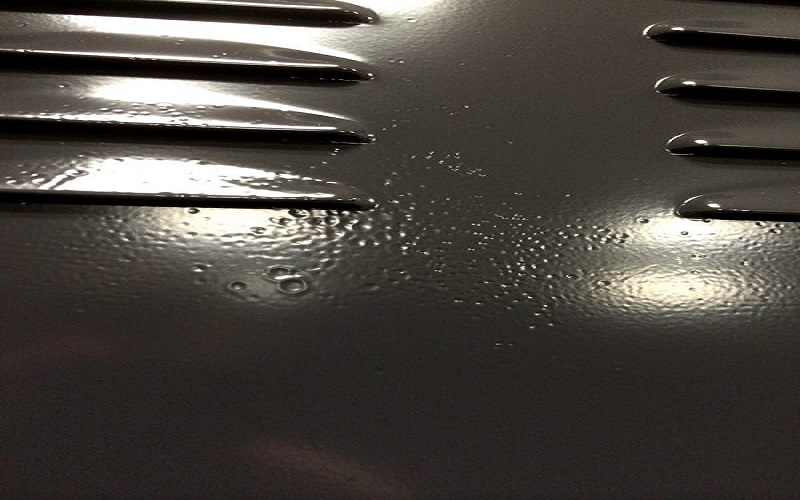
JA Many customers come to Metaltech 1 with a bad experience: Mechanical products that have just been processed at other factories have not been put into use for a long time. Paint blisters and rust are pushed out from the inside, causing the paint to peel off in pieces. So what is the core cause?
In the finishing industry, there is an immutable principle: “The quality of the paint layer depends 80% on the surface treatment of”. If the workpiece is not clean, no matter how expensive the powder coating becomes meaningless. Today, let's join Metaltech 1 to dissect in detail the standard powder coating process and decode the secret to creating durable protective films that challenge time.
1. Why does the powder coating blister and peel?
When metal blanks undergo mechanical processing such as laser cutting, bending, and composite welding, their surfaces become coated with a large amount of impurities:
- Industrial grease (used to lubricate machinery, cool cutting tips).
- Solder slag, charcoal blackened at joints.
- The iron oxide layer (rust) forms because the embryo is left for a long time in a humid environment.
If the processing workshop skips cleaning, or does it over the speaker and then puts it straight into the paint spray booth, the paint powder will stick to that layer of impurities instead of directly sticking to the metal surface. After only a short time, the inner underground rust layer will grow, puffing and breaking the outer paint film.
2. Technical standard metal surface treatment process
To completely eliminate the above risk, before being put into the drying oven and spray booth, the product must go through a strict treatment chemical tank system. This is the most important step to create a perfect “surface for powder coating adhesion.

Step 1: Degreasing
The product is dipped into a specialized alkaline solution tank. In this step, the entire layer of industrial grease and dirt on the surface of the workpiece and deep in the narrow nooks and crannies of the weld will be completely decomposed and cleaned.
Step 2: Remove rust before painting (Rust Removal)
This is a vital step for products made from carbon steel (black steel). The embryo is transferred to dip into an acid bath (usually H2SO4 or standard concentration HCl). The rust removal process before painting will completely remove the iron oxide layer, the mill scale layer produced from steel rolling and the black burn marks left by the laser/welded arc. The metal surface will reveal the clean, bright original workpiece.
Step 3: Surface Conditioning
After rinsing the acid with water, the product is passed through a shaping tank. The chemical in this tank is responsible for neutralizing free ions, smoothing the surface and acting as a catalyst to prepare for the next most important step.
Step 4: Phosphating – “Key” of adhesion
The embryo is dipped into a zinc phosphate tank (Zinc Phosphate). Here, a chemical reaction occurs, creating an ash-gray zinc phosphate crystal film that covers the entire metal surface. This membrane has two magical effects:
- Creates micro-roughness, giving the paint powder a tight grip like lithium anchor hooks, preventing peeling.
- Creates a rust-resistant passive film just under the paint. If the paint film later gets a small scratch due to impact, this phosphate layer will isolate the scratch, preventing rust from spreading around.
Step 5: Wash water and Dry
The product is washed again several times through overflow water tanks to remove excess chemicals, then put into a drying oven at a temperature of 100 – 120 degrees Celsius to completely remove moisture before entering the spray booth powder coating.
3. Professional treatment tank system at Metaltech 1
Reading this far, you have probably realized why the cheap powder coating process often comes with the risk of peeling. To save chemical costs and time, many small factories often shorten the process, only taking towels through grease and then taking them to paint.
At Metaltech 1 Co., Ltd. (Tam Phuoc Industrial Park, Dong Nai), we do not accept compromises on quality.
- We are proud to own a multi-stage chemical treatment dip tank system (multi-stage cleaning tank system) operated according to industry standards.
- All mechanical components, from the smallest machine parts to large pedestal frames, must undergo cleaning, rusting and phosphating processes deep in this tank system.
- Chemical solutions are always periodically tested for concentration by the QC team to ensure the best reaction effect.
That is Metaltech 1's strongest commitment to color fastness, oxidation resistance and outstanding longevity for partners' mechanical products.
If you are looking for a supplier metal powder coating services reputation, don't just look at the price list or the gloss of the finished product. Ask them about the surface treatment system.
Come to Metaltech 1 to experience the standard closed machining process, where each product is cared for from the depths of the surface structure.
